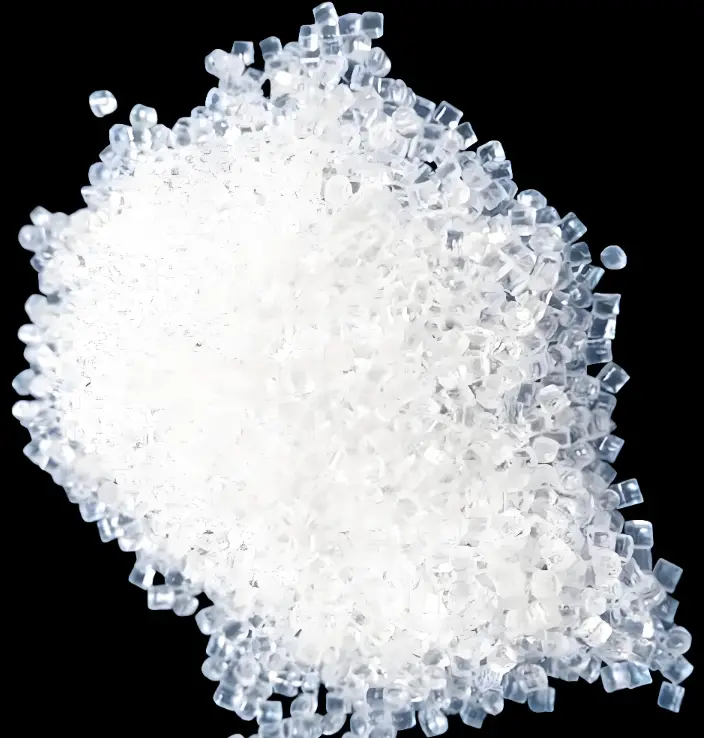
Polystyrene is one of the five major commodity plastics, yet it is often the least understood. It is not one material but a family: transparent GPPS, expandable EPS and impact-resistant HIPS. This overview explains the three grades, their markets, and the policy trends reshaping demand.
Polystyrene is produced by polymerizing styrene monomer and is one of the five commodity plastics alongside PE, PP, PVC and ABS. Its three commercial forms serve very different markets. GPPS is crystal-clear and glassy but brittle, used where transparency matters. EPS is the expandable grade that becomes polystyrene foam. HIPS is toughened with butadiene rubber to produce an opaque, impact-resistant material for appliances and electronics.
The three grades share the same chemistry but behave as separate products with separate cost structures and supply chains, which is why the market tracks them independently.
GPPS is transparent, easy to color, simple to process and rigid, with good dimensional stability. Its drawbacks are equally well known: brittleness, modest heat resistance, and susceptibility to many solvents.
HIPS trades transparency for toughness, capturing the appliance and electronics markets where GPPS would crack. EPS abandons solid properties entirely in exchange for insulation and cushioning. Choosing the right grade means deciding which trade-off fits the application.
All three grades are easy to process: GPPS and HIPS by injection molding and thermoforming, EPS by steam molding. This processability, together with low cost and good rigidity, keeps PS competitive wherever clarity or dimensional accuracy matters.
Consumption of PS spans several markets. Packaging is the largest outlet for GPPS and HIPS — trays, containers and lids — while HIPS dominates appliance housings, refrigerator liners and electronics. EPS feeds building insulation, protective packaging and disposable food containers.
Other outlets include toys, stationery and cosmetic packaging, where PS’s transparency and ease of decoration are valued. The breadth of these markets is one reason PS remains relevant despite competitive pressure from other resins.
In packaging, the move toward thinner and lighter parts favors PS for its rigidity at low wall thickness, while recycled-content requirements are beginning to influence grade selection in regulated markets such as Europe.
China is both a major producer and consumer of PS. Domestic capacity has expanded steadily in recent years, and the market is characterized by ample supply, intense competition and thin margins on commodity grades. Differentiation comes from specialty and impact-modified grades.
The balance between domestic output and imports shapes regional pricing. Changes on either side of the supply chain — naphtha costs, recycling rules or single-use bans — are quickly reflected in local PS prices.
Single-use plastic bans weigh most heavily on EPS food service, while GPPS and HIPS remain comparatively stable in packaging and appliances. Producers are responding by upgrading grades and shifting product mix toward insulation and specialty applications.
For buyers, the takeaway is to match the grade to both the regulatory environment and the physical requirement. PS is not a single product, and understanding which family serves which market is the first step to reliable sourcing.
Longer term, the industry is watching whether recycled PS can close the loop in food-contact applications, where current recycling technologies still face contamination and regulatory hurdles.
For buyers, the key is to position GPPS and HIPS correctly. GPPS remains the value choice where clarity and rigidity matter and impact loads are low; HIPS is the workhorse where toughness is needed at modest cost. Neither is exposed to the policy pressure that targets EPS food service.
The circular economy is the industry’s next frontier. Mechanical recycling of PS is improving, and several producers now offer recycled-content grades for non-food and, increasingly, food-contact applications. The direction of travel points to a two-tier market: virgin grades for demanding uses and recycled grades for regulated or cost-sensitive ones.
Finally, a practical sourcing note. PS is a mature, widely available resin, and price differences between producers are usually small on commodity grades. What varies is reliability of supply and consistency of quality, so most buyers qualify two sources per grade. Given the ongoing rationalization of capacity, that redundancy is worth maintaining.
Market outlook: Market outlook: PS demand is expected to hold steady, with the mix shifting away from EPS food service and toward packaging, appliances and insulation. Producers that invest in recycled grades and specialty products are better placed than those competing purely on commodity price.